
How to Choose a 3D Rendering Company: 12 Questions to Ask
Table of Contents
Every rendering studio's website shows stunning images, which is exactly the problem. You can't judge a rendering company by its portfolio alone, because portfolios show the best work, not the typical work, and never the missed deadlines behind it.
Knowing how to choose a 3D rendering company means asking about what the gallery hides. The twelve questions below do that, and the answers will separate your shortlist in a single phone call.
What should you ask a 3D rendering company before you hire one?
Ask about the things that go wrong: revisions, timelines, ownership and accuracy. Studios that work professionally answer instantly, in writing, with numbers attached. Studios that don't will hesitate, and that hesitation is your data. Ask all twelve, and listen for the red flag after each.
| Question | What a good answer sounds like | Red flag |
|---|---|---|
| 1. Can you show me a full project? | Every image from one job, start to finish | Never the same building twice |
| 2. Who will work on my project? | Named artist or lead, direct contact | "Our production team" |
| 3. What do you need from me? | An intake list, then questions back | "Just send whatever you have" |
| 4. How many revision rounds? | A number and a definition, in writing | Unlimited revisions |
| 5. What's the realistic timeline? | Stage dates that include your feedback | "Two weeks" |
| 6. How do you price? | A scope with an exclusions list | A price before seeing drawings |
| 7. Have you rendered my type of project? | Examples in your category | "Rendering is rendering" |
| 8. How do you match my design? | A review step you can see | "Our artists have a great eye" |
| 9. What resolution and formats? | Outputs specified per use | One file, one size |
| 10. Who owns the images and model? | Licence terms explained on the call | Terms nobody can explain |
| 11. How will we communicate? | One contact, feedback in writing | No process for collecting comments |
| 12. What happens after delivery? | Archived project, priced updates | Deliver and disappear |
1. Can you show me a full project, not just highlights?
Ask to see every image from one recent project, start to finish. A gallery of 30 hero shots from 30 projects tells you less than 8 consistent images from one, because consistency across views is where average studios fall apart.
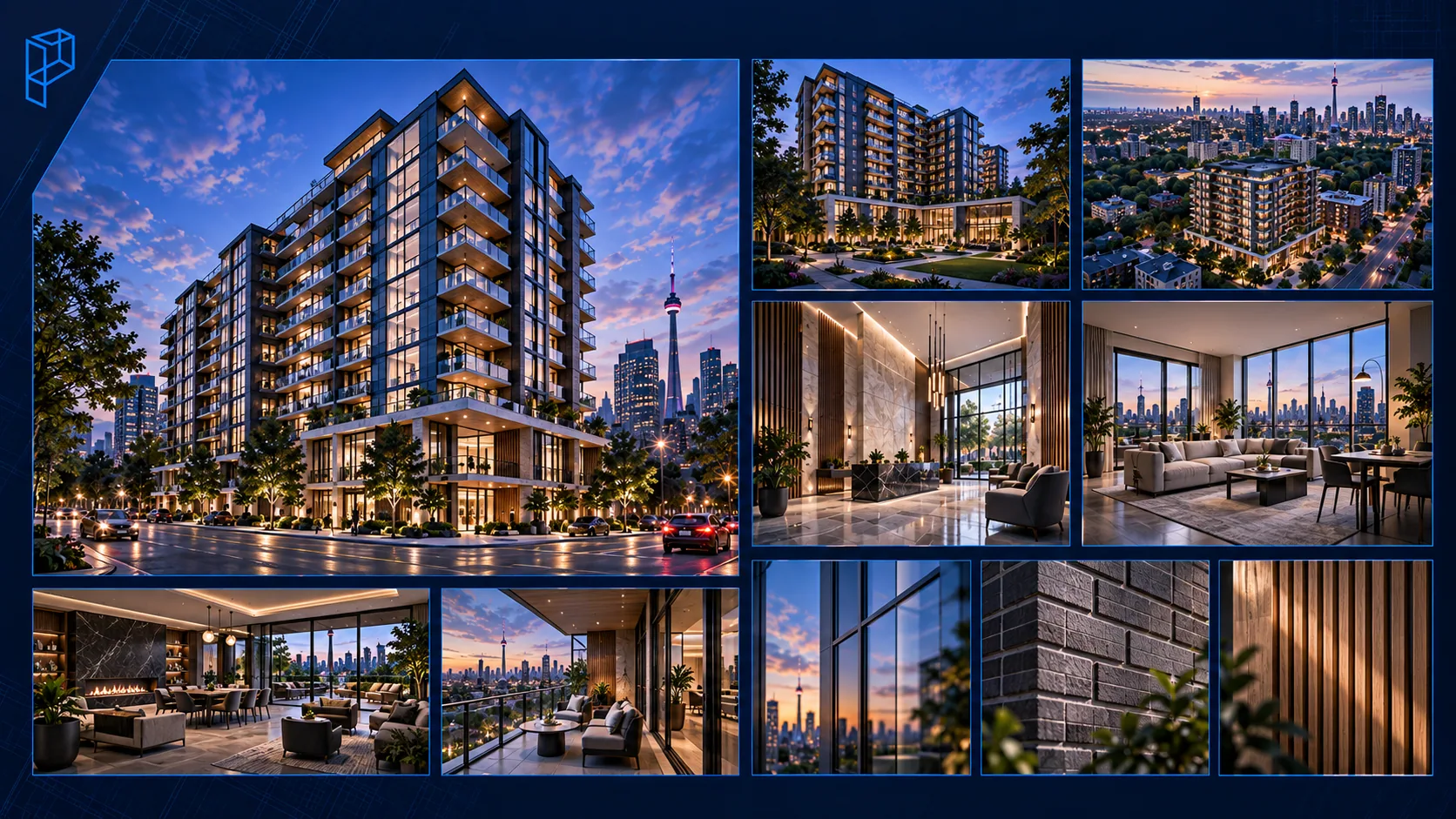
While you're looking, run the zoom test: enlarge one image to full screen and study the glass. In premium work, windows reflect a believable sky and surroundings. In cheap work, they're flat blue rectangles. Then check material scale, like brick courses roughly 7 cm high and wood grain that doesn't repeat in visible tiles, and whether people and trees cast shadows that match the sun. Pasted entourage with mismatched shadows is the fastest tell of rushed work.
Red flag: a portfolio that never shows the same building twice.
2. Who will actually work on my project?
Some studios produce in-house, others resell outsourced work with a markup and a delay. Neither label decides quality, but you deserve to know who holds the pen, in which time zone, and who checks the work before you see it.
Ask whether you'll have direct contact with the artist or team lead. Every relay in the chain adds a day to every answer. Here's how that plays out: you send a comment on Monday, the account manager forwards it Tuesday, the outsourced artist in another time zone reads it Wednesday, and the corrected draft reaches you Friday. The same comment handled directly comes back in a day.
Red flag: vague answers about "our production team" with no names attached.
3. What do you need from me to start?
A professional studio hands you a clear intake list before any work begins. Expect it to cover:
- Drawings: plans, elevations, sections, and a site plan if context matters.
- Finish schedules and material selections, or the references that stand in for them.
- Reference images for mood, lighting and the level of realism you expect.
- Deadlines, and where the images will be used.
If you want to arrive prepared, our guide to the files needed for a 3D rendering project covers the full checklist.
Notice whether they ask you questions back. Good intake sounds like: "Is the siding the charcoal or the cedar option? What time of day should the hero shot be? Is the landscaping from the plan final?" A studio that starts without asking will render its assumptions, and you'll pay for the corrections in revision rounds.
Red flag: "Just send whatever you have" with no follow-up questions.
4. How many revision rounds are included, and what counts as one?
This is where rendering budgets quietly explode. Get the number of included rounds in writing, then get the definition, because "revision" can mean anything from a lighting tweak to a redesigned facade.
Ask what happens when you change the design mid-project versus correcting the studio's error. The distinction matters in dollars: swapping the brick colour you approved last week is a billable change, while fixing a window the artist placed on the wrong elevation is not. Good studios charge for the first, absorb the second, and say so without being cornered.
Red flag: unlimited revisions. It sounds generous, but it usually means slow, unstructured production priced into your quote.
5. What's your realistic timeline, and what slows it down?
You want a schedule with stages, not a single promised date. An honest answer sounds like: "Model by day 3, first draft day 5, your feedback within 48 hours, finals 2 days after sign-off." A studio that just says "two weeks" is guessing. Our breakdown of how long an architectural rendering takes shows what honest stage timelines look like.
Ask what happens if the deadline is missed and who carries the risk. Even the answer's tone tells you something.
Red flag: timelines with no mention of your feedback turnaround, because those schedules break the first time you take a day to reply.
6. How do you price, and what's not included?
Per image, per project, or hourly, any model works when the boundaries are clear. What you're really asking for is the exclusions list: extra camera angles, format variations, rush delivery, animation frames, post-launch changes.
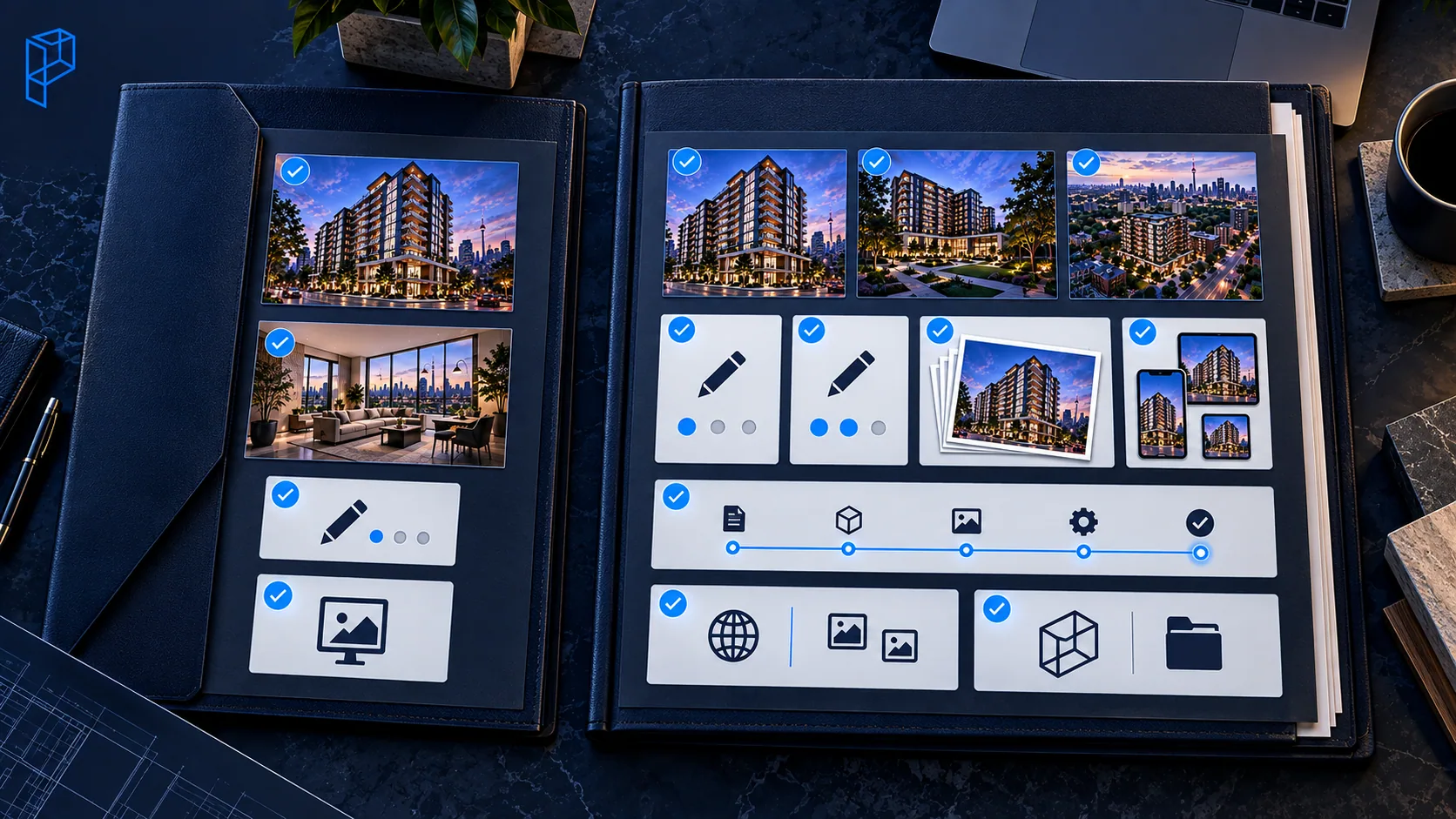
Compare quotes by scope, not by number. Two studios quote the same job: one at a lower price for 2 views with 1 revision round at web resolution, another slightly higher for 3 views, 2 rounds, print resolution, and social crops included. The first quote grows past the second by the first change request. The cheapest quote is usually the one that defined the least.
Red flag: a price that arrives before anyone has looked at your drawings.
7. Have you rendered my type of project?
A studio brilliant at cozy interiors can stumble on a 40-storey tower, and the reverse is just as true. Ask for examples in your category, whether that's residential exteriors, condo marketing, or commercial interiors. The two disciplines really are different, as our guide to exterior versus interior rendering sets out.
You're not looking for a perfect match. You're checking that your project won't be their experiment.
Red flag: a portfolio in a completely different niche, offered with "rendering is rendering."
8. How do you make sure the rendering matches my design?
Accuracy is process, not talent. Ask how finishes get matched, whether materials come from your schedule or the artist's judgment, and who checks dimensions against the drawings before drafts go out.
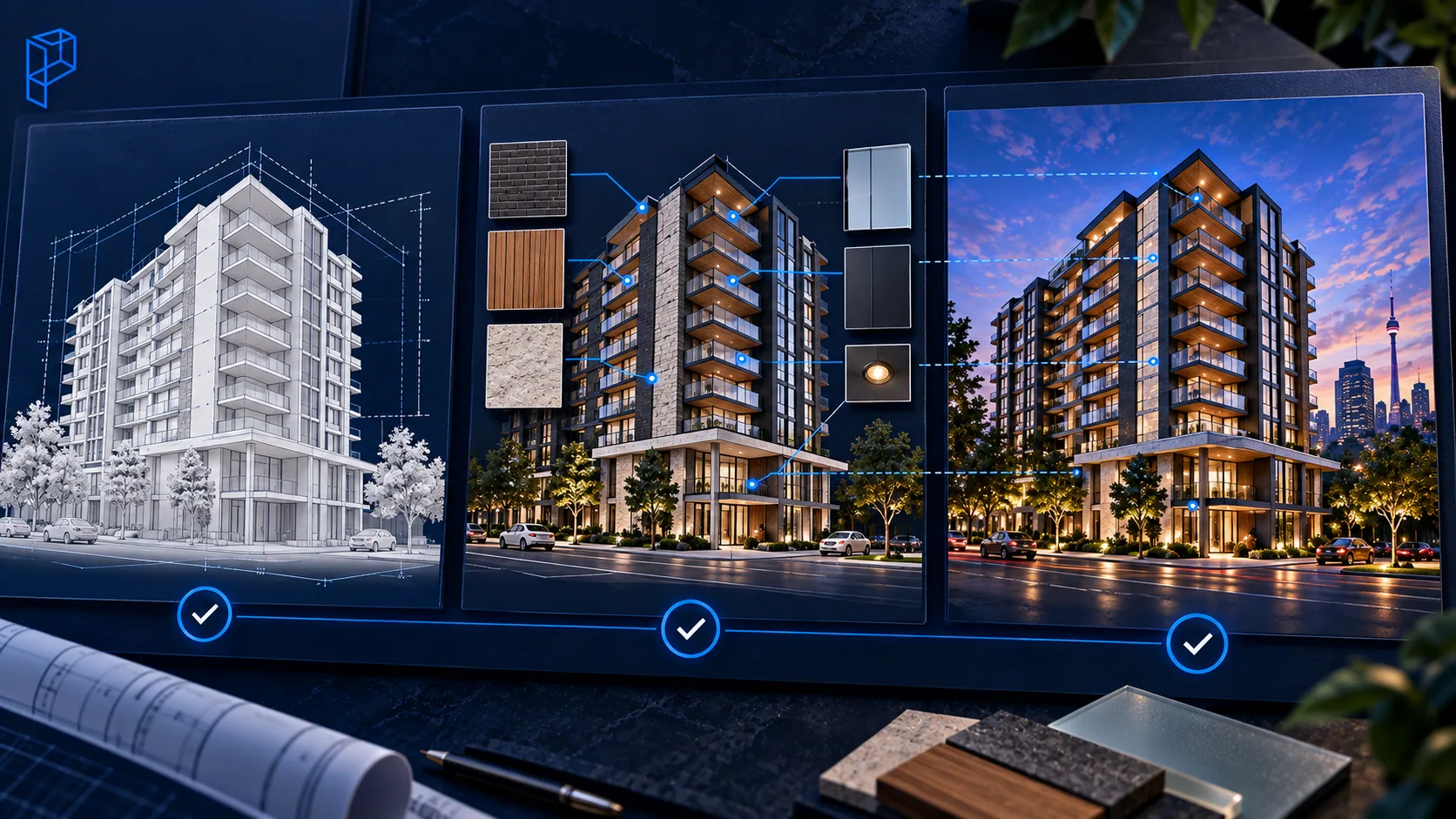
The best answer describes a review step you can see. For example, some studios send a clay render, the untextured model, for you to verify geometry against drawings before any materials go on, then a digital material board matching your finish schedule for sign-off. By the time you see the first full draft, the expensive mistakes are already impossible. We walk through that finish-matching step in our guide to visualizing finishes and materials.
Red flag: "Our artists have a great eye." Taste is not a quality-control system.
9. What resolution and formats will I receive?
Confirm you'll get files sized for every planned use. As a rule of thumb, 1920 px wide covers websites, 4K to 6K covers brochures and magazine print, and hoarding or billboard work needs custom output matched to the print house's spec. Upscaling a web file for a 10-metre hoarding produces visible blur at exactly the size everyone will see it, and re-rendering later costs more than ordering correctly now.
State your uses upfront and let the studio spec the outputs.
Red flag: one file, one size, no questions about where the images will appear.
10. Who owns the images and the 3D model?
Read the licensing terms before you sign, because "you get the images" is not the same as "you own the images." Some studios retain rights, restrict usage, or charge again when a new campaign reuses old renders.
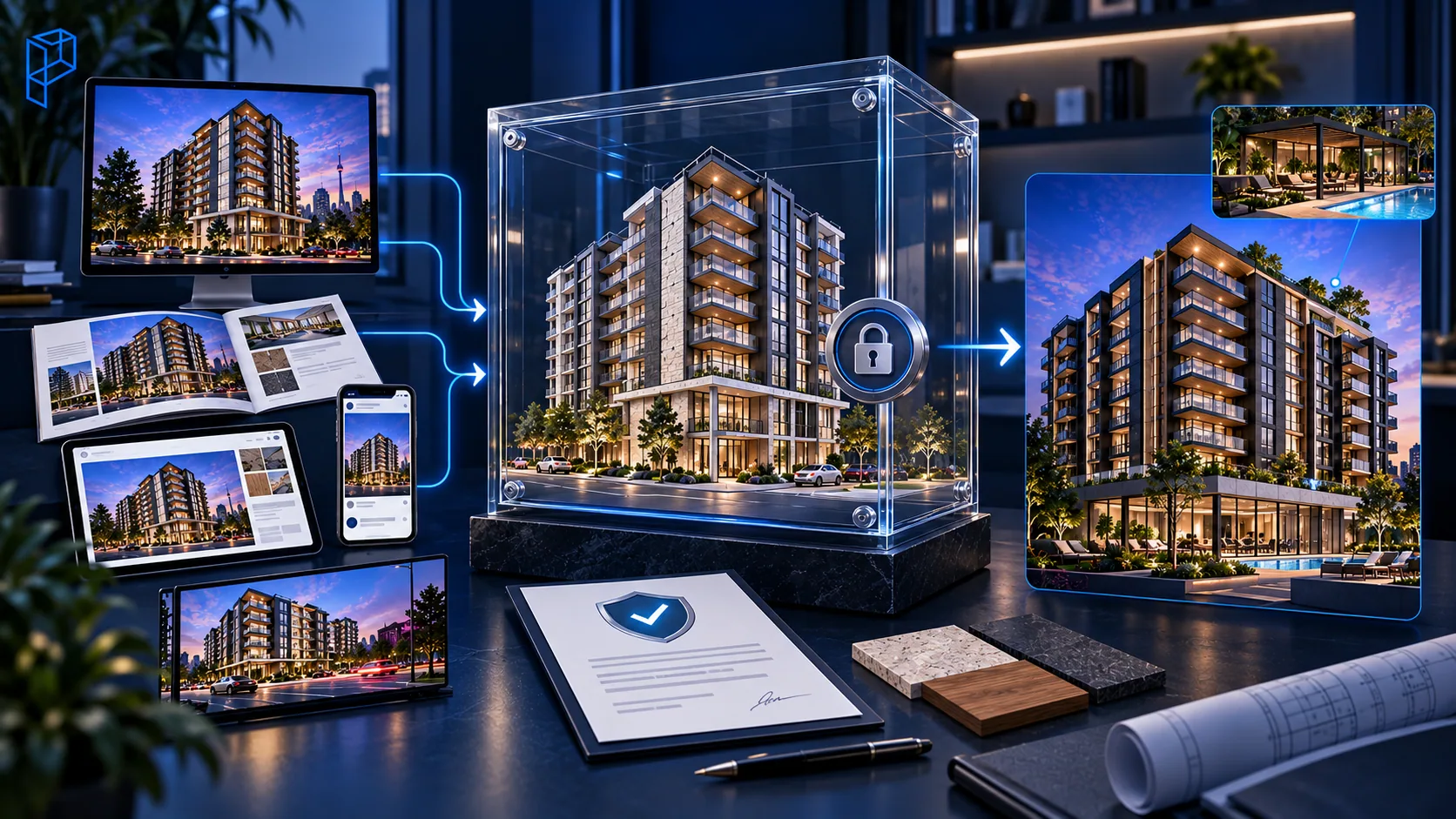
Ask specifically about the 3D model, because it's where real money hides. Say phase two launches next year with a new facade colour and two new amenity spaces: with the archived model, that's days of work at a fraction of the original fee. Without it, you're paying for the entire building to be rebuilt from drawings. Ask what model reuse costs, how long projects stay archived, and whether the model can be released to you. Developers planning a multi-phase launch should read our guide to pre-construction renderings before signing anything.
Red flag: licensing terms nobody can explain on the call.
11. How will we communicate during production?
You want one named contact, scheduled draft deliveries, and a channel where feedback lives in writing. Scattered emails with five stakeholders replying separately is how details get lost and deadlines slip.
Ask how they handle consolidated feedback and what they need from your side to keep pace. The good version is specific: one markup document or annotation link per round, all stakeholders' comments merged, submitted by a named person. If your architect, your sales team, and your partner each email separately, the studio ends up refereeing your internal disagreements at your expense.
Red flag: no process for collecting your comments, which means your revisions will be interpreted from memory.
12. What happens after delivery?
Projects come back. Finishes change, phase two launches, a new angle is needed for an ad. Ask whether the studio archives your project, for how long, and what small updates cost after delivery.
A studio confident in the relationship plans for the second project during the first.
Red flag: deliver-and-disappear, with every future change quoted as a brand-new job.
You don't need perfect answers to all twelve. You need clear ones. A studio that says "we charge for that" plainly is safer than one that promises everything and defines nothing.
How do you put these 12 questions to work?
Copy the list, book calls with two or three studios, and ask every question on it. The comparison takes an hour and saves weeks, because the right studio reveals itself in how it answers, not what it shows. Then compare the written quotes by scope.
- Shortlist two or three studios whose portfolios include your project type.
- Send each the same drawings and the same brief, so the quotes are comparable.
- Book a call and ask all twelve questions, noting how each one is answered, not only what is said.
- Line the quotes up by scope: views, revision rounds, formats, usage rights, timeline.
- Pick the clearest answers, not the lowest price. The cheapest quote usually defined the least.
Start with us. At Pyctom Labs, every quote already answers these questions in writing: defined revision rounds, stage-by-stage timelines, output formats, and usage rights, with one named contact from brief to delivery. Review full projects in our portfolio, then send us your drawings and grill us on all twelve. We'll have answers before you finish asking.
Frequently asked questions
What should I look for in a 3D rendering company's portfolio?
Consistency across multiple views of the same project, believable lighting and materials, and work in your project category. Isolated hero shots reveal very little, so ask to see one complete project rather than a highlight reel.
How much should 3D rendering services cost?
Pricing varies by scope, complexity, and revision terms, which is why quotes should follow a review of your drawings. Treat any price quoted sight-unseen as a red flag, and compare quotes by what they include rather than by the number.
Should I choose a local rendering company or work remotely?
Rendering is delivered digitally, so process matters more than postcode. Choose the studio with the clearest communication structure and timeline, wherever it sits. A local studio does make site visits and in-person reviews easier for larger projects.
Who owns the renderings after the project?
Whatever the contract says, which is why you ask before signing. Standard practice grants you broad marketing usage, but model ownership and reuse terms differ between studios, and the model is where the money hides on phase two.
How do I compare quotes from different rendering companies?
Line them up by what's included: number of views, revision rounds, output formats, and usage rights. Identical prices can hide very different scopes, and the thinner scope grows past the fuller one by the first change request.
Is unlimited revisions a good sign?
Usually not. It sounds generous, but it tends to mean slow, unstructured production with the cost priced into your quote. A defined number of rounds with a clear definition of what counts as one is the safer offer.