
Architectural Rendering Styles Explained: Photorealistic, Conceptual, White Renders and Sketch
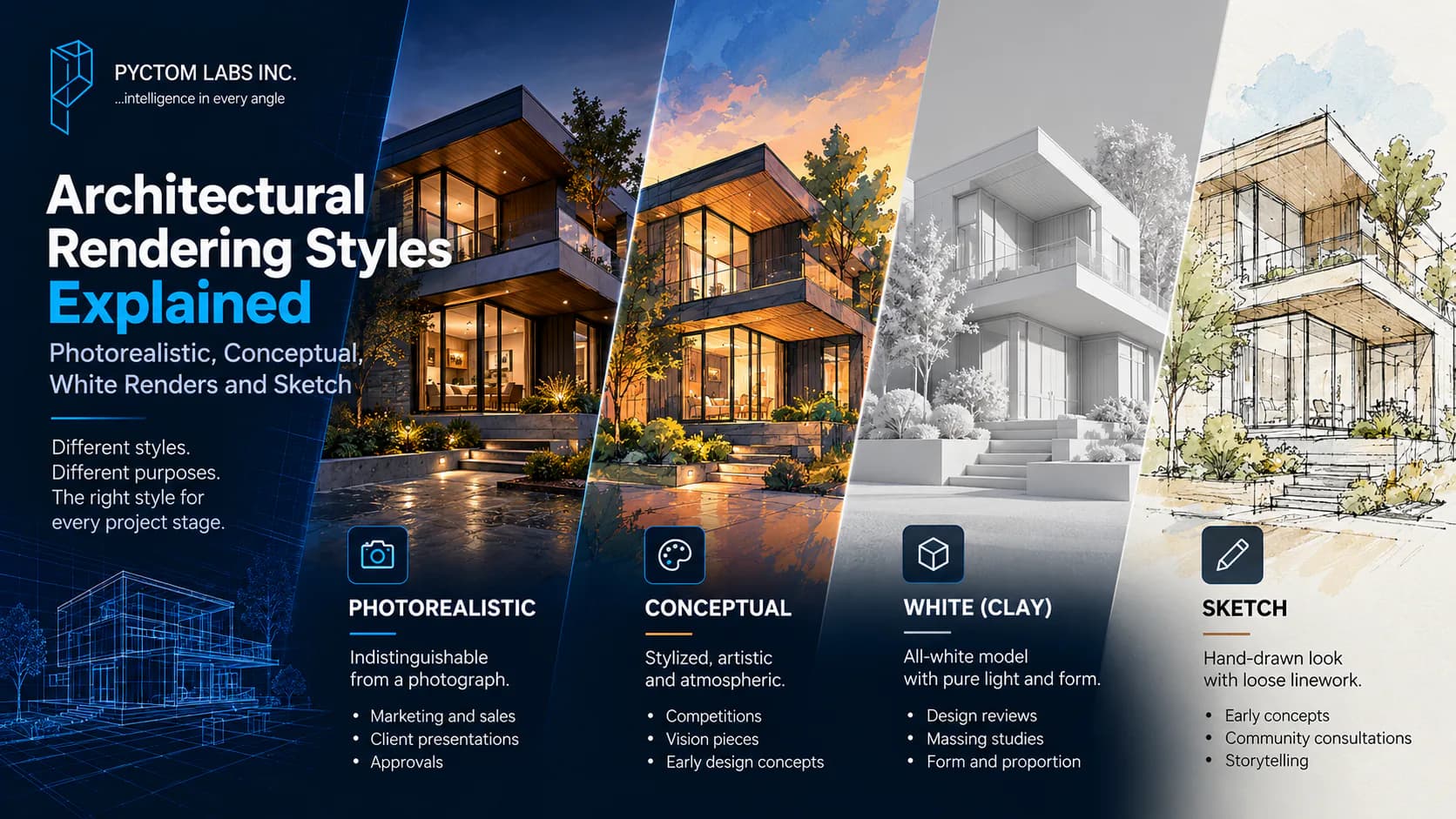
Table of Contents
Architectural rendering styles are not interchangeable looks. Each one communicates a different level of certainty about the design. A photorealistic image says the decisions are made. A sketch says the ideas are still open. If you send the wrong style to the wrong audience, the image works against you. It invites finish debates during concept design, or it looks unfinished at a sales launch.
In this guide, we will walk you through the four main rendering styles and what each one costs. We will also show you how to match the style to your project stage.
What are the 4 architectural rendering styles?
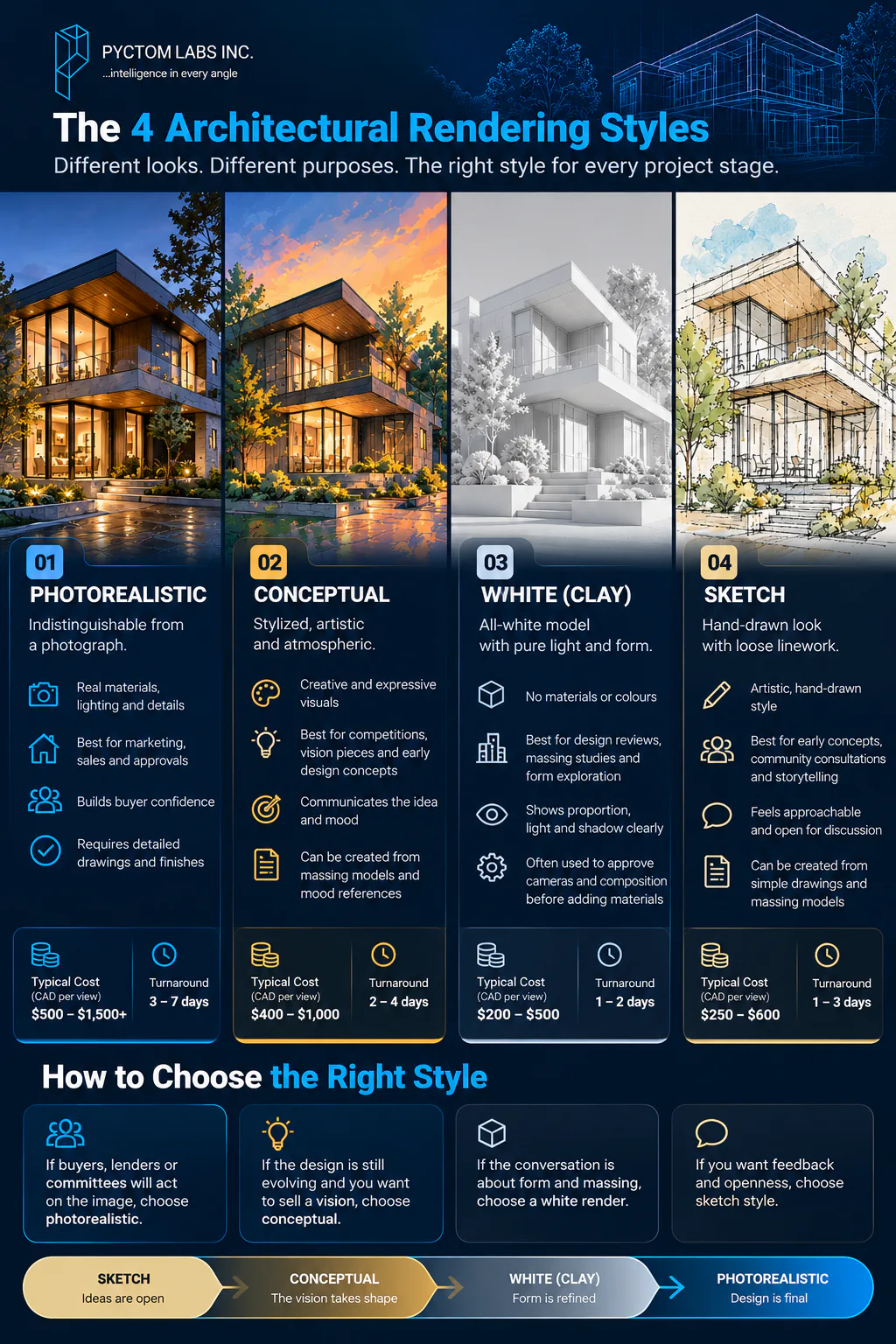
Photorealistic, conceptual, white (clay) and sketch. They run from most finished and most expensive to loosest and cheapest, and each suits a different stage of a project.
| Style | The look | Best for | Typical cost (CAD, per view) | Turnaround |
|---|---|---|---|---|
| Photorealistic | Indistinguishable from photography | Marketing, sales, approvals | $500 – $1,500+ | 3 – 7 days |
| Conceptual | Stylized, atmospheric, artistic | Competitions, vision pieces | $400 – $1,000 | 2 – 4 days |
| White (clay) render | All-white model, pure light and form | Design reviews, massing studies | $200 – $500 | 1 – 2 days |
| Sketch | Hand-drawn look, loose linework | Early concepts, storytelling | $250 – $600 | 1 – 3 days |
Costs assume the 3D model is being built for the first time. If the model already exists, a new style on the same view costs a fraction of these numbers. For the full price picture, see our guide to 3D rendering costs in Canada.
How does each architectural rendering style work?
Each style answers a different question about your project, from "does the idea work?" to "is this ready to buy?". They also follow the typical life of a project, from loose to final.
Read them in order below.
What is photorealistic rendering?
Photorealistic rendering aims for one result: an image nobody can tell from a photograph. Every material, shadow, and reflection is computed to match real-world physics. This is the style of pre-construction marketing, listing imagery, and high-stakes client presentations. Buyers commit money to what looks real.
It is also the most expensive and slowest style, and for good reason. Realism demands accurate materials, detailed modeling, and long render times. It also demands the most from you. The studio needs your finish schedule, fixture selections, and near-final drawings. Every visible surface must be specified. A builder pitching a finished custom home design is the classic use. You should reach for this style when the design is resolved. The audience must be ready to act on the image.
What is conceptual rendering?
Conceptual rendering trades strict realism for mood. Colours may be heightened, lighting may be dramatic, and details may dissolve into atmosphere. The image communicates a feeling and a vision rather than a specification.
This style shines in competitions, early client vision decks, and public-facing storytelling. It signals ambition without promising exact finishes. A developer teasing a project before finishes are chosen is a typical use. The input barrier is lower too. The studio can work from massing models and mood references rather than full documentation. If your design will still evolve, a conceptual image invites the right conversation. It keeps the discussion on ideas instead of tile choices.
What is a white render (clay render)?
A white render, often called a clay render, strips away every material and colour. The entire model is rendered in soft white, so only form, proportion, and light remain. Architects love this style because nothing distracts from the architecture itself.
White renders are also a working tool inside professional studios. Cameras, composition, and geometry are approved on clay renders before any materials are applied. That order saves expensive rework later. Our walkthrough of the design visualization process shows exactly where this stage sits in production. As a deliverable, white renders suit design reviews, massing studies, and minimalist portfolio imagery.
What is sketch style rendering?
Sketch style rendering makes a digital model look hand-drawn. Linework stays visible, and colour arrives as a loose wash. The image feels like an architect's drawing rather than a machine's output. The style is warm, human, and deliberately unfinished.
That unfinished feeling is the point. Sketch renders tell an audience that ideas are open for discussion. That makes them ideal for early concepts, community consultations, and heritage-sensitive projects. They also demand the least from you, since loose drawings and a massing model are enough to start. If a photoreal image would feel presumptuous, a sketch feels like an invitation.
Note: Style is a message about certainty, so match it to your design stage. If you show clients photorealism too early, they fixate on the countertop instead of the floor plan. Every unresolved finish becomes a debate. Save realism for decisions, and use looser styles for discussions.
What other rendering styles will you hear about?
Dusk and night renders, photomontage, axonometric and cutaway views, and watercolour filters. Each is a variation of the four main styles.
A few more terms come up in quotes and briefs:
- Dusk and night renders: photorealistic images set at twilight, with glowing interiors. They cost more than daytime views and are the favourite hero shot for marketing.
- Photomontage, or photo-matching: composites the rendered building into a real photograph of the site. Some planning authorities require this format for view studies, because it shows true context.
- Axonometric and cutaway views: slice or tilt the building to explain how it works inside. They suit brochures, wayfinding, and investor decks.
- Watercolour and other artistic filters: cousins of sketch style. They suit heritage projects and high-end residential presentations.
If your image is going to a planning board or committee, ask what format they expect before ordering. An accurate photomontage often carries more weight there than a glossy marketing render.
How do you choose the right rendering style?
Match the style to who will see the image and how settled the design is. The more final the decision, the more realistic the style.
- If buyers, lenders, or committees will act on the image, choose photorealistic.
- If the design is still evolving and you're selling a vision, choose conceptual.
- If the conversation is about form, massing, or composition, choose a white render.
- If you want feedback and openness, especially from communities, choose sketch style.
- If the budget is tight in early phases, start loose and save photorealism for the final design.
Can you mix rendering styles across one project?
Yes, and most successful projects do. Sketch or conceptual images carry the early vision, white renders support design development, and photorealism arrives once the design is locked.
Most successful projects use several styles in sequence, not one style throughout. A sketch or conceptual image carries the early vision. White renders support design development and internal reviews. Photorealistic imagery arrives at the end, when the design is locked and the marketing begins.
The economics support the sequence too. The 3D model built for early clay renders becomes the base for the final photoreal set. Each stage reuses the work of the last. You pay for the model once and change only its dressing.
How can Pyctom help you pick the right style?
We produce all four styles from one 3D model and one pipeline, and we tell you honestly which style your stage actually needs.
Every style above comes from the same foundation. You need a well-built 3D model and an artist who knows what the image must achieve. At Pyctom Labs, we produce all four styles from one consistent pipeline. We will also tell you honestly which style your stage actually needs. You can compare the styles side by side in our portfolio.
Send us your project and tell us who the image is for. The right style follows from that answer.
Frequently asked questions
What are the main architectural rendering styles?
The four main styles are photorealistic, conceptual, white (clay) renders, and sketch. Each one signals a different level of design certainty.
Which rendering style is the most expensive?
Photorealistic rendering costs the most. Accurate materials, detailed modeling, and long render times all add hours. White and sketch styles cost the least.
What is a white render or clay render?
It is an image rendered entirely in soft white with no materials. Only form, light, and proportion remain. Studios also use clay renders to approve cameras before adding materials.
When should I use sketch style instead of photorealistic?
Use sketch style when the design is still open and you want discussion. It suits early concepts and community consultations. Use photorealistic when decisions are final and the image must sell.
Can one project use more than one rendering style?
Yes, and most should. A common sequence runs sketch for early vision, clay renders for design reviews, and photorealism for final marketing.
Does the rendering style change the 3D model?
No. The same model can be dressed in any style. That is why starting loose and finishing photoreal is cost-efficient.
Disclaimer: The information provided in this blog is for general informational purposes only. For professional assistance and advice, please contact experts.