
3D Product Modeling vs Product Photography: Pros, Cons, and Costs
Table of Contents
What if your product is still in production, but you want to start marketing, collecting leads, and generating sales before the first unit is even ready? With 3D product rendering, you can create photorealistic product images before manufacturing is complete.
In this article, we'll take a look at how it compares to traditional product photography and when either type is right for Canadian home brands.
How does 3D product modeling work?
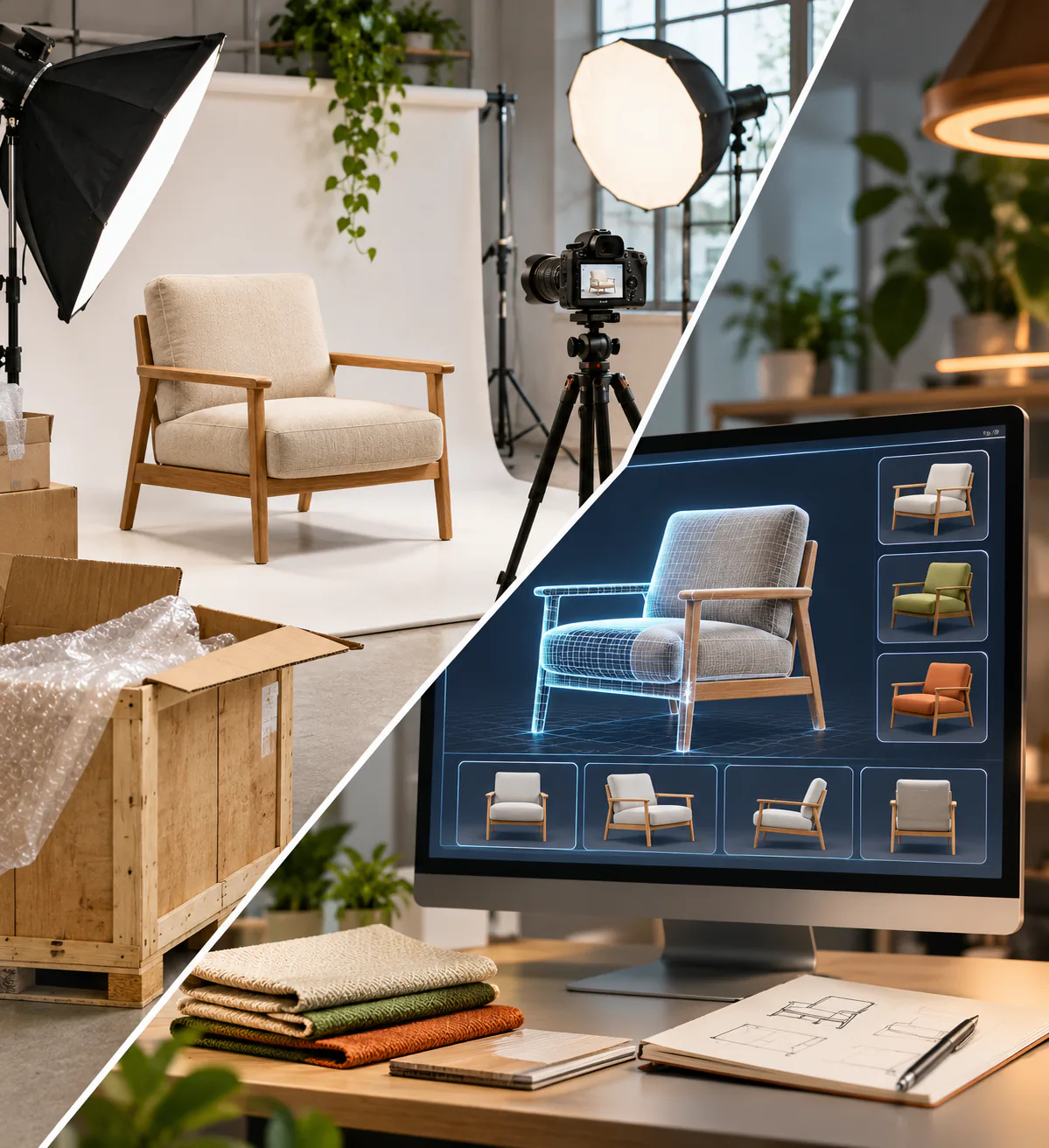
An artist builds a digital copy of your product, adds lights and a virtual camera, and the computer produces the final image, called a render. The product itself never has to exist.
3D product modeling means building a digital copy of a product. An artist copies its shape, materials, and finish inside software. Then lights and a virtual camera are added to the scene. The computer produces a final image called a render.
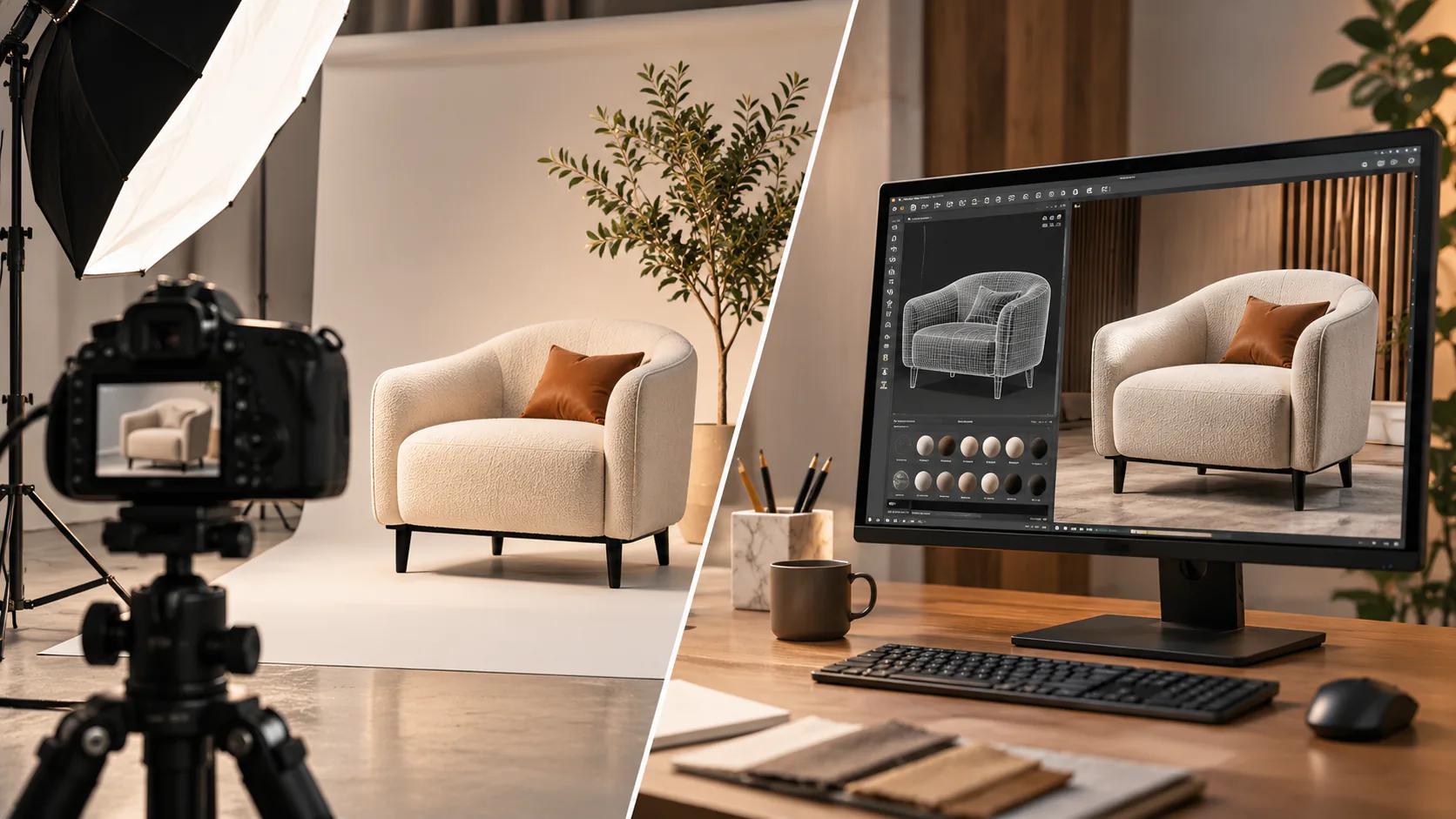
These images can take several forms, depending on what you need. One common option is a clean white background image for listings. You can also get room style scenes and views that spin around. The same model can also be used for video and augmented reality. Augmented reality lets a shopper place the product in their own room using a phone.
Can a 3D model place your product in room scenes?
Yes. Modeling is not just the product on its own. A studio can build the whole room around it. So you do not need to rent or build a real set.
For example, a sofa needs to appear in several living rooms. We can set up each space digitally, with different floors, walls, and light. No studio rental and no set crew are needed. This is how our 3D furniture rendering work is usually produced.
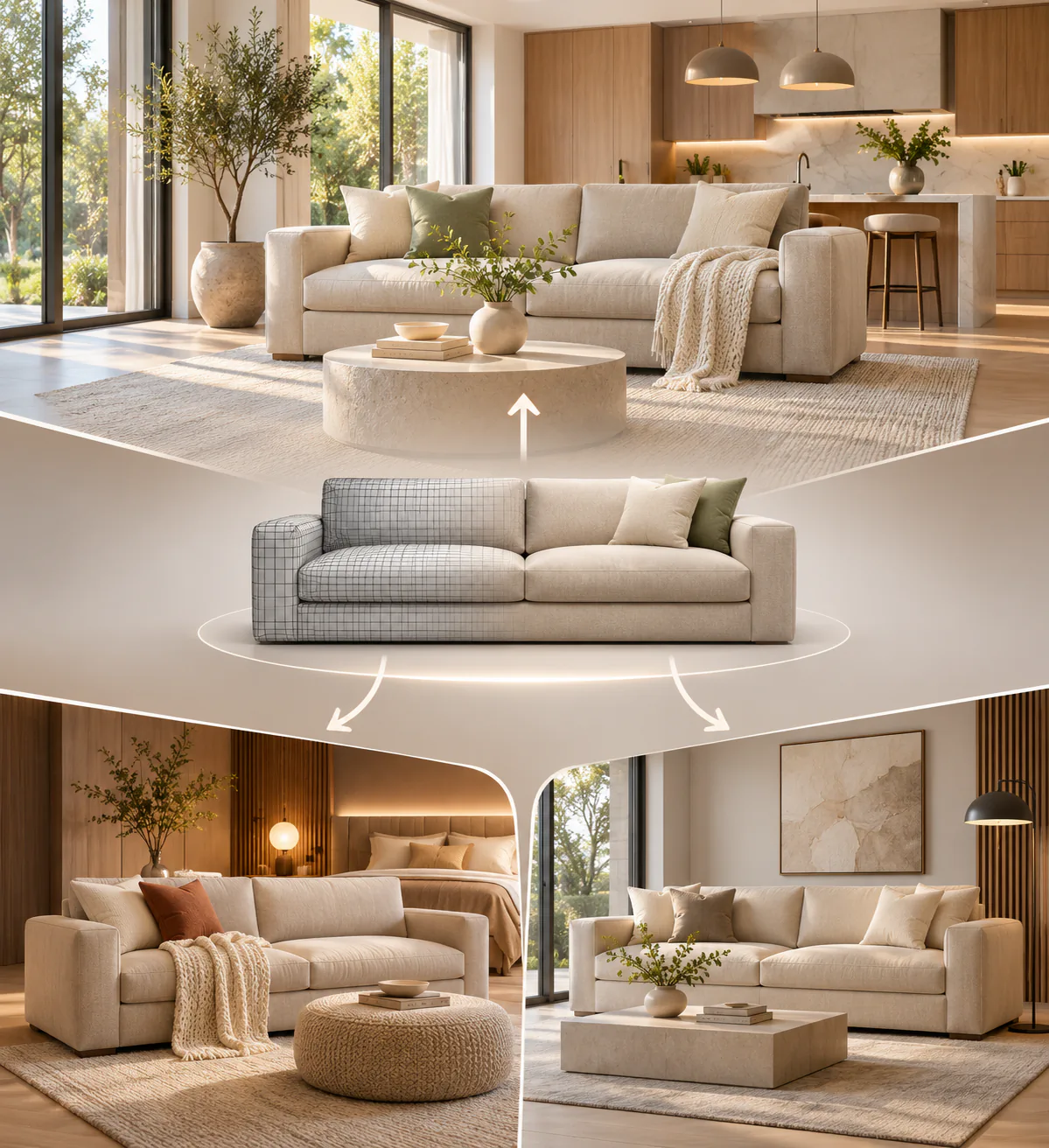
The same works across very different rooms. One pendant light can sit in a bright kitchen scene. It can also sit in a warm, cosy bedroom scene. Both images come from a single model, with no second shoot.
What are the strengths of product photography?
Photography captures a real product with real materials and true detail. For items that already exist, and especially for soft or natural textures, a shoot is often the easiest option.
Photography is not going anywhere. For items that already exist, a photo shoot is often the easiest option. Nothing is built digitally. You just need lighting and a camera. One catch applies in Canada. The sample must reach the studio first. Long distances and winter shipping can add delays.
Some materials also look better in a photo. Think of soft rugs, natural wood grain, or woven textures. A camera captures those fine surfaces with little effort. In our experience, products you can touch often photograph well on the first try.
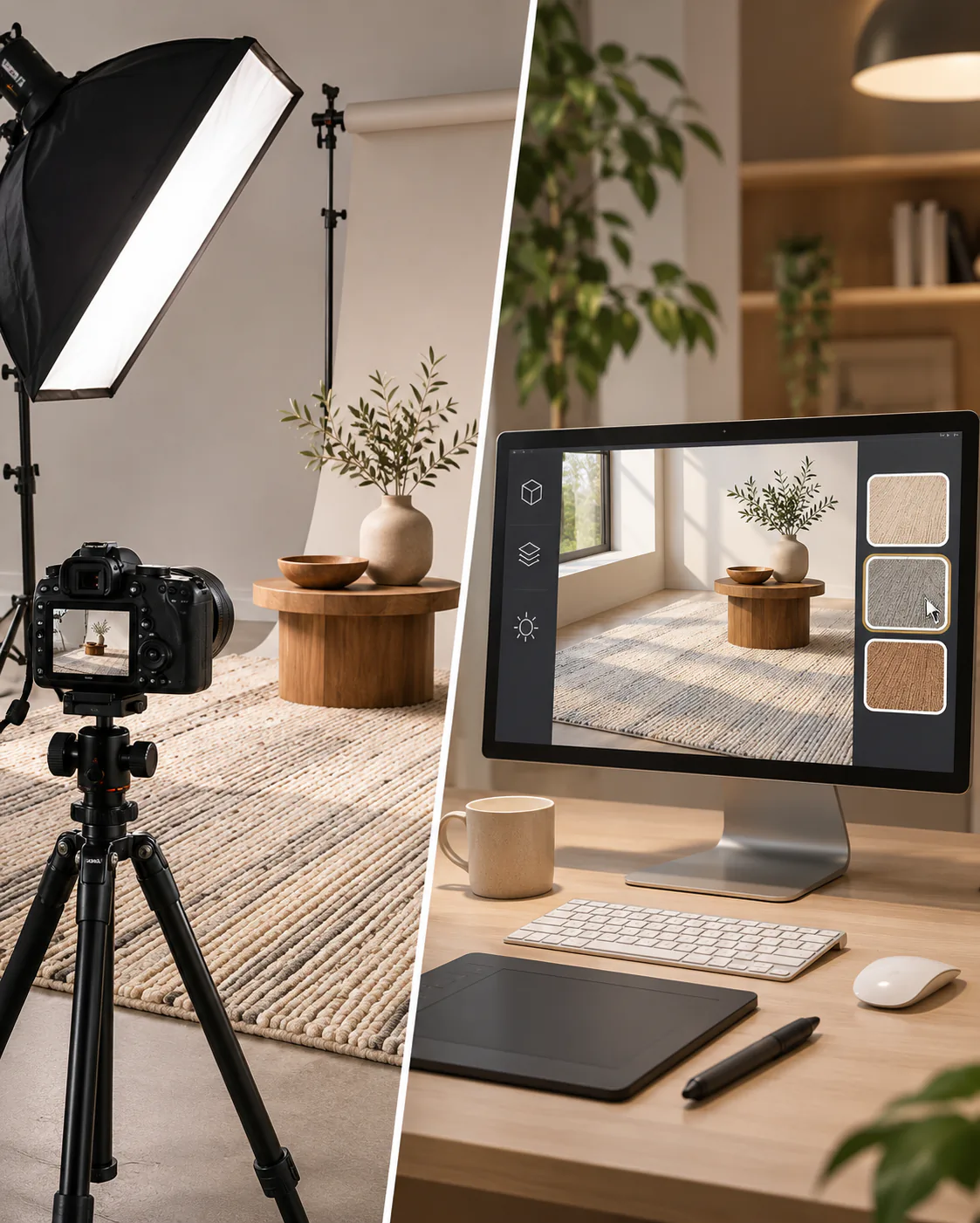
Advisor Insight: For a rug launch, real photography was still the better choice. The soft texture looked more real in the photo than in an early render.
What is the difference between CGI and product photography?
Photography records what already exists. 3D modeling shows what you plan to sell, without needing the physical product.
The two methods solve different problems. The table below shows the main differences at a glance.
| Factor | Product photography | 3D product modeling |
|---|---|---|
| Needs the physical product | Yes | No |
| Best for existing items | Strong | Fine |
| Best for prototypes | Not possible | Strong |
| Easy colour and variant swaps | Limited | Easy |
| Upfront setup cost | Lower | Higher |
| Cost per extra image | Higher | Lower |
| Speed for one simple shot | Fast | Slower first time |
Read the table as a guide, not a final answer. Many brands end up using both methods together. Using both often gives the best coverage for a full catalogue. For how product rendering fits alongside architectural work, see our guide to 3D product and industrial rendering.
When should you use 3D rendering or photography?
Use photography when you hold finished, textured stock. Use 3D modeling when the product is still a prototype or comes in many variants.
Neither method is better in every situation. The right choice depends on your product and your timeline. Here is how the decision usually breaks down for home goods.
When is product photography the better choice?
Photography makes sense once you hold real, finished stock. It is fast, familiar, and easy to brief. Make it your default in these cases:
- You already have samples in hand and ready to shoot
- The product has rich texture, like fabric, leather, or timber
- You need a small number of simple images quickly
- You want honest, unedited proof of the real item
When is 3D product modeling the better choice?
Modeling works best before stock exists, or when you have many versions. It builds the product digitally, so nothing physical is needed. Many Canadian brands make stock overseas. That stock can spend weeks in transit by sea. A render lets you list the item before the shipment lands. It tends to pay off in these cases:
- The item is still a prototype or an early sample
- You sell many colours, fabrics, or sizes of one design
- You want matching, consistent images across a whole range
- You plan to reuse the model for video or website views
How much does 3D product rendering cost in Canada?
Expect a one-time model build of about 150 to 800 CAD for a home product, then a per-image charge of roughly 30 to 600 CAD depending on how styled the render is.
Prices vary widely, so treat these as planning figures. The ranges below reflect the current Canadian market. Costs change with the product, the detail, and the studio. Two separate charges usually apply. It helps to keep them apart.
The first is a one time cost to build the digital model. For a home product, that often falls between 150 and 800 CAD. Very detailed items can cost more than that. The second charge covers each image you render from the model.
- Simple white background render: often 30 to 150 CAD per image
- Styled room scene or main showcase image: often 150 to 600 CAD or more
- Normal product photo, shot in volume: often 20 to 100 CAD per image
- Styled photography with sets or models: usually higher, and priced per day
The real saving comes after the model exists. New angles and colours cost far less than a fresh photo shoot. Confirm exact pricing with your studio, since every quote depends on the job. For architectural price ranges, see our guide to 3D rendering costs in Canada.
Advisor Insight: One homeware brand reshot photos three times over colour problems. A single 3D model later fixed every variant without another shoot.
What 3D rendering mistakes should you avoid?
Flat materials, poor lighting and inaccurate colour. A weak render looks fake and hurts trust, and most problems come from those few details.
A 3D render only helps when it looks believable. Knowing the common mistakes early protects both your budget and your brand.
Why do materials and lighting matter most?
Bad renders rarely fail on the shape. They fail on surfaces and light instead. Plastic looks flat, metal looks dull, and fabric looks lifeless. A good studio spends most of its time on those details.
Why does accurate colour matching matter?
Customers trust the colour they see on screen. A render must match the true product finish closely. Ask for a physical sample or an exact colour reference. This matters most for paint, fabric, and stained wood. Honesty also matters under Canadian law. The Competition Act bans misleading product images. Keep every render true to the real item.
Advisor Insight: The renders that look fake usually fail on materials and light. We spend most of our effort there, not on the shape.
How can Pyctom bring your product to market faster?
We go through your product list with you and mark which items suit a camera and which suit a render, then build the models for the ones that need them.
The smartest brands do not pick one method for everything. They decide product by product across the catalogue. A finished, textured item can call for a shoot. A prototype or a wide variant range points toward modeling.
So if you are planning a launch, start with your product list. Our portfolio shows how our renders hold up next to real photography. Take a look, then tell us what you are shipping next.
Frequently asked questions
What is 3D product modeling?
It is the process of creating a digital version of a product. In software, an artist replicates its form, materials and texture. The computer then creates realistic images based on that model. You can use those images for listings, ads, and websites.
Is 3D product rendering cheaper than photography?
It depends on how many images you need. The first model is more expensive than a single photo. From there, additional angles and colours get considerably cheaper. Rendering is usually more cost effective for large ranges.
Can 3D renders look as real as photos?
Yes, if it is done properly. Modern renders can be almost impossible to tell from photos. Materials, lighting and colour are key to achieving good results. Weak renders usually fail on those details, not on shape.
Do I need the physical product for a 3D render?
No, and this is a great benefit. A studio can create a model based on drawings without the need to see the actual product. Technical specs, prototypes or reference images will suffice. This enables you to sell products before they ever reach your warehouse.
How long does a product render take?
A basic product model and image can take a couple of days. More complicated objects or whole scenes take a longer time. Changes and extra angles also add time. If you have clear references outlined at the beginning, the process will be quicker.
Will Amazon or Shopify accept 3D rendered images?
Most sites, including Amazon.ca and Shopify, accept realistic renders. Shopify is a Canadian company from Ottawa. The primary guideline is that images should portray the product honestly. There are some rules and categories that are more restrictive than others. Always check the guidelines for your platform and category.
What files do I need to provide for a 3D model?
Send any product drawings, dimensions, or CAD files you have. Add reference photos and exact material or colour details. A physical sample helps most when colour accuracy is critical. More accurate inputs produce a more accurate final image. Our checklist of files needed for 3D rendering covers the rest.
Can I reuse a 3D model for different colours or variations?
Yes, and this is one of its biggest strengths. Once the model exists, swapping colours is quick and cheap. The same applies to fabrics, finishes, and simple size changes. You avoid a separate photo shoot for every single variant.
Is photography still worth it if I have 3D models?
Most of the time yes, because the two complement each other well. Photography can provide tangible evidence and is good for capturing touch textures. Renders cover prototypes, variants and matching catalogue images. Many brands mix both to obtain full coverage of the product.
How much does 3D product modeling cost?
The prices usually depend on complexity, detail, and studio. The price of one home product model is 150 to 800 CAD. There is typically an additional charge to each rendered image. Request a quote that matches your product and scope of work.
Disclaimer: The information provided in this blog is for general informational purposes only. For professional assistance and advice, please contact experts.