
3D Landscape Rendering: Visualizing Outdoor Spaces, Pools and Site Design
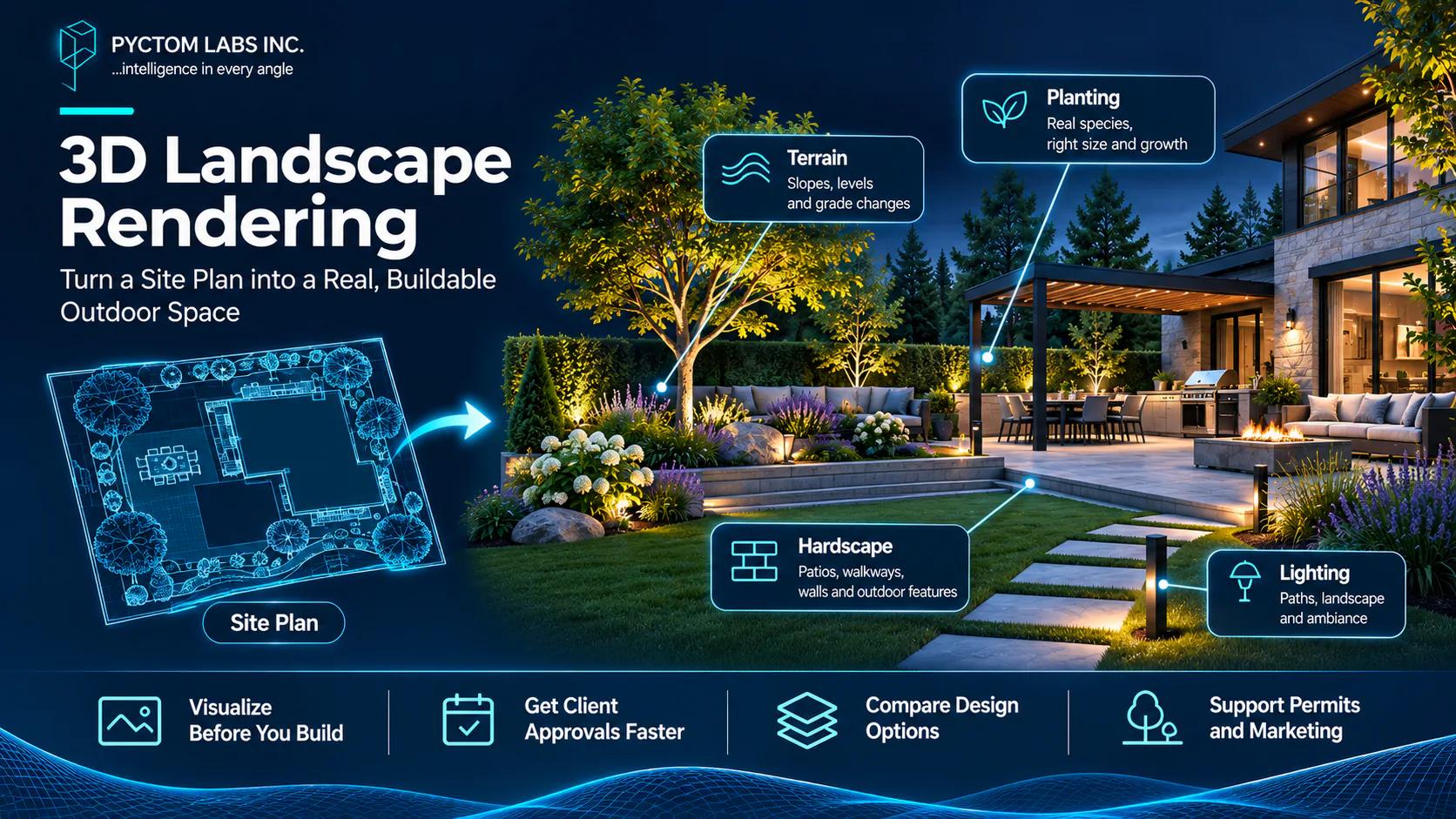
Table of Contents
3D landscape rendering turns a flat site plan into an outdoor space your client can picture themselves in. Landscapes are the hardest designs to explain on paper. Plants grow, ground levels change, and a 2D plan hides all of it. If your client approves a backyard from a plan alone, the surprises arrive during construction. Surprises at that stage cost real money.
In this guide, we will walk you through what landscape rendering shows and what it costs in Canada. We will also cover what pools, gardens, and site designs each need.
What is 3D landscape rendering?
It is the photorealistic visualization of an outdoor space, built from your site plan and planting design. Terrain, hardscape, plants, water, lighting and furniture all appear as the finished space.
The model includes terrain, hardscape, plants, water features, lighting, and furniture. The client sees the finished space rather than a symbol legend.
The craft differs from exterior building rendering in one big way: nature is irregular. Believable landscapes need varied plants, natural ground textures, and soft outdoor light. Rows of identical trees are the fastest giveaway of cheap work. Terrain matters too. Slopes, steps, and retaining walls only make sense to clients when they see them in three dimensions.
What are landscape renderings used for?
Client approvals, upselling, permits and marketing. Those are the four places outdoor visuals earn their cost.
- Client approvals: homeowners sign off on designs they can finally picture.
- Upselling: a rendered outdoor kitchen or fire feature sells itself better than any description.
- Permits and committees: decks, pools, and grading changes often need visual support.
- Marketing: landscape contractors and pool builders win the next job with the last project's imagery.
What are the main types of landscape rendering?
Backyard and garden, pool and water feature, outdoor living, and site design or master plan rendering. Each sells a different experience, so the views should match it.
What does a backyard and garden rendering show?
Residential backyard renderings show the full composition: lawn, planting beds, patio, pathways, and lighting. The best views sit at eye level from the house. That is how the owners will see their investment every day.
One decision matters more than clients expect. Choose whether plants are shown at installation size or at maturity, and label the image accordingly. A garden rendered at year five looks lush, but the day-one reality disappoints if nobody set that expectation.
What makes a pool and water feature rendering work?
Pool renderings live or die on the water. Realistic reflections, caustics, and wet surfaces are technically demanding. That is why pool imagery separates professional studios from template work. Evening views with pool lighting are the proven hero shot. Glowing water sells the lifestyle harder than any daytime angle.
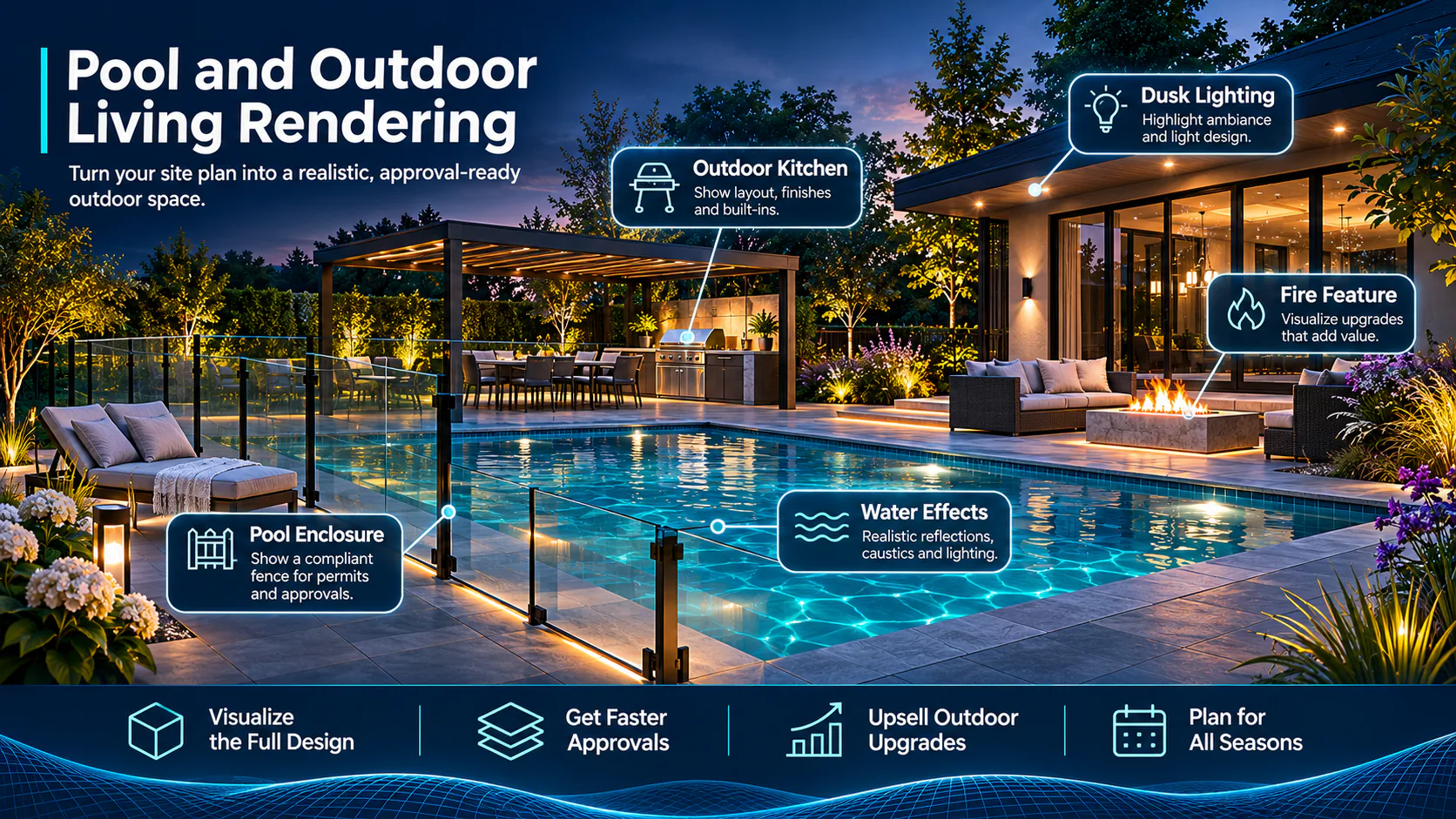
Pool builders also use these images for permits and for spouse sign-off. Every contractor knows which of those is the real approval process. One Canadian detail helps here. Municipalities require compliant pool enclosures, so show the fence in the render. An image that already meets the bylaw smooths the permit and prevents a redesign later.
How does outdoor living rendering help you upsell?
Outdoor kitchens, covered patios, fire features, and pergolas are upsell territory, and renderings are the sales tool. Show the client their own backyard with the upgraded package next to the base package. That comparison converts far better than a catalogue photo of someone else's yard.
These scenes borrow from interior rendering craft, because materials, furniture, and warm lighting carry the image. Dusk settings work best, with the fire lit and the kitchen glowing.
When do you need a site design or master plan rendering?
Larger projects, from multi-lot developments to parks and commercial grounds, need the aerial perspective. A rendered site plan or aerial view shows circulation, grading, phasing, and how buildings sit in the landscape. That is exactly what approval boards and investors ask about. Our guide to 3D aerial rendering covers when that view is worth it.
For developments, the landscape aerial doubles as marketing. Buyers purchase into a community, not just a lot. The site rendering is where that community first exists.
How do seasons, growth and time of day change a landscape rendering?
The same design can be rendered in summer, autumn or winter, at installation size or maturity, and in daytime or at dusk. Each variation comes from the same model at modest extra cost.
Landscape imagery has choices buildings don't. The same design can be rendered in summer lushness, autumn colour, or winter structure. Canadian clients increasingly ask for the winter view. A design that only works in July is half a design.
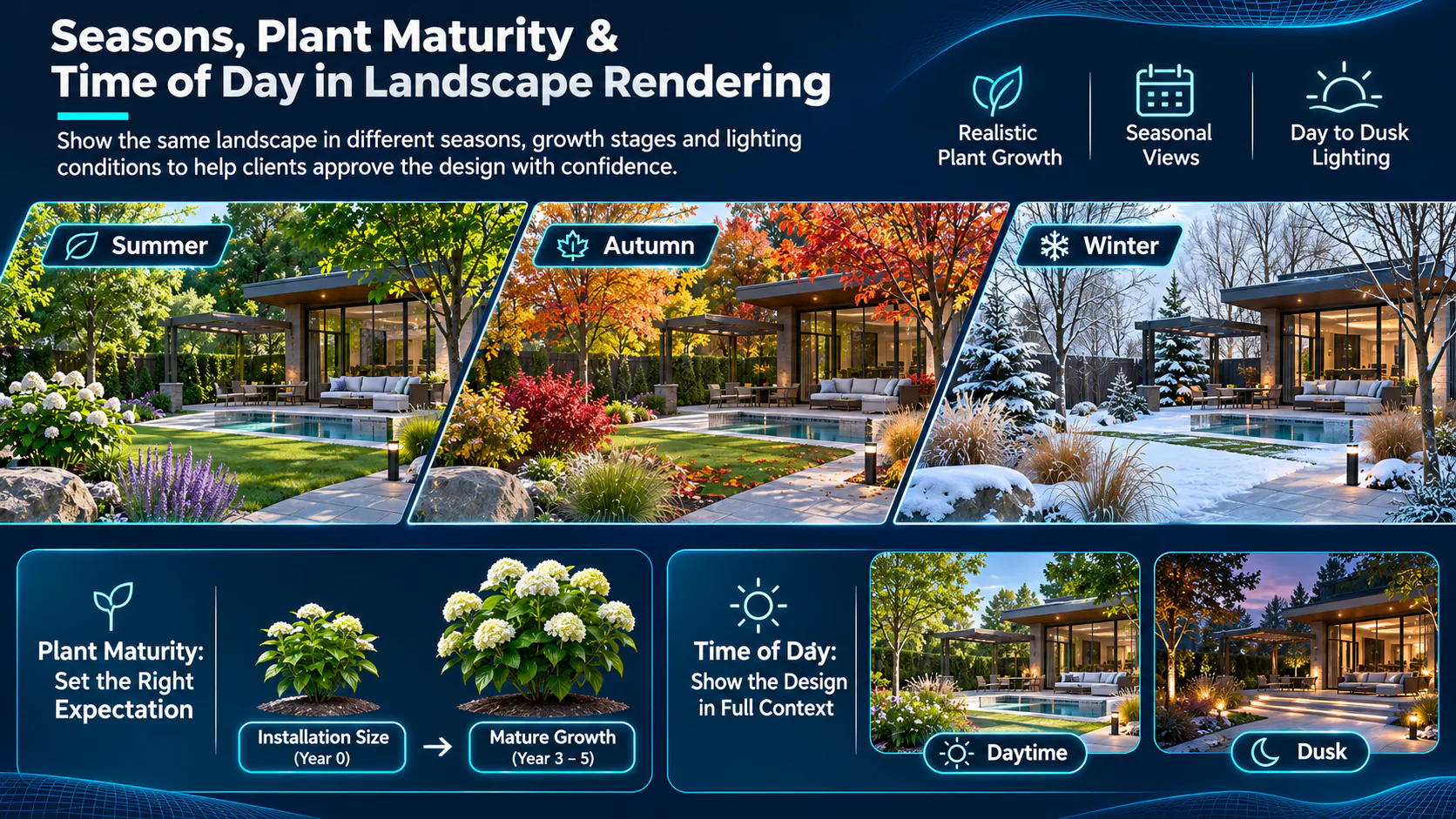
Time of day is the other lever. Daytime views read the layout clearly, while dusk views sell atmosphere, lighting design, and outdoor living. Most projects need one of each, and both come from the same model at modest extra cost.
Timing matters in Canada too. Contractors sell spring projects through the winter. The smart window for ordering renders is January to March, before the season starts. If the planting plan changes after approval, swapping species is a quick revision, not a rebuild.
Note: Ask how plant maturity will be handled before work starts. Serious studios model region-appropriate species at a stated growth stage, and they will say so on the image. If a rendering shows tropical plants in an Ontario backyard, the image loses credibility. So does the design.
How much does 3D landscape rendering cost in Canada?
A backyard view runs $400 to $1,200, a pool scene $600 to $1,500 and a site aerial $1,000 to $3,000. Seasonal or dusk variations of an existing view cost $150 to $400.
| Deliverable | Typical cost (CAD) | Timeline |
|---|---|---|
| Backyard or garden view | $400 – $1,200 | 3 – 6 business days |
| Pool scene with water effects | $600 – $1,500 | 4 – 7 business days |
| Outdoor living or upsell scene | $500 – $1,200 | 3 – 6 business days |
| Site plan or landscape aerial | $1,000 – $3,000 | 5 – 8 business days |
| Landscape flythrough animation (30–60 sec) | $2,500 – $8,000 | 2 – 4 weeks |
| Seasonal or dusk variation of an existing view | $150 – $400 | 1 – 2 business days |
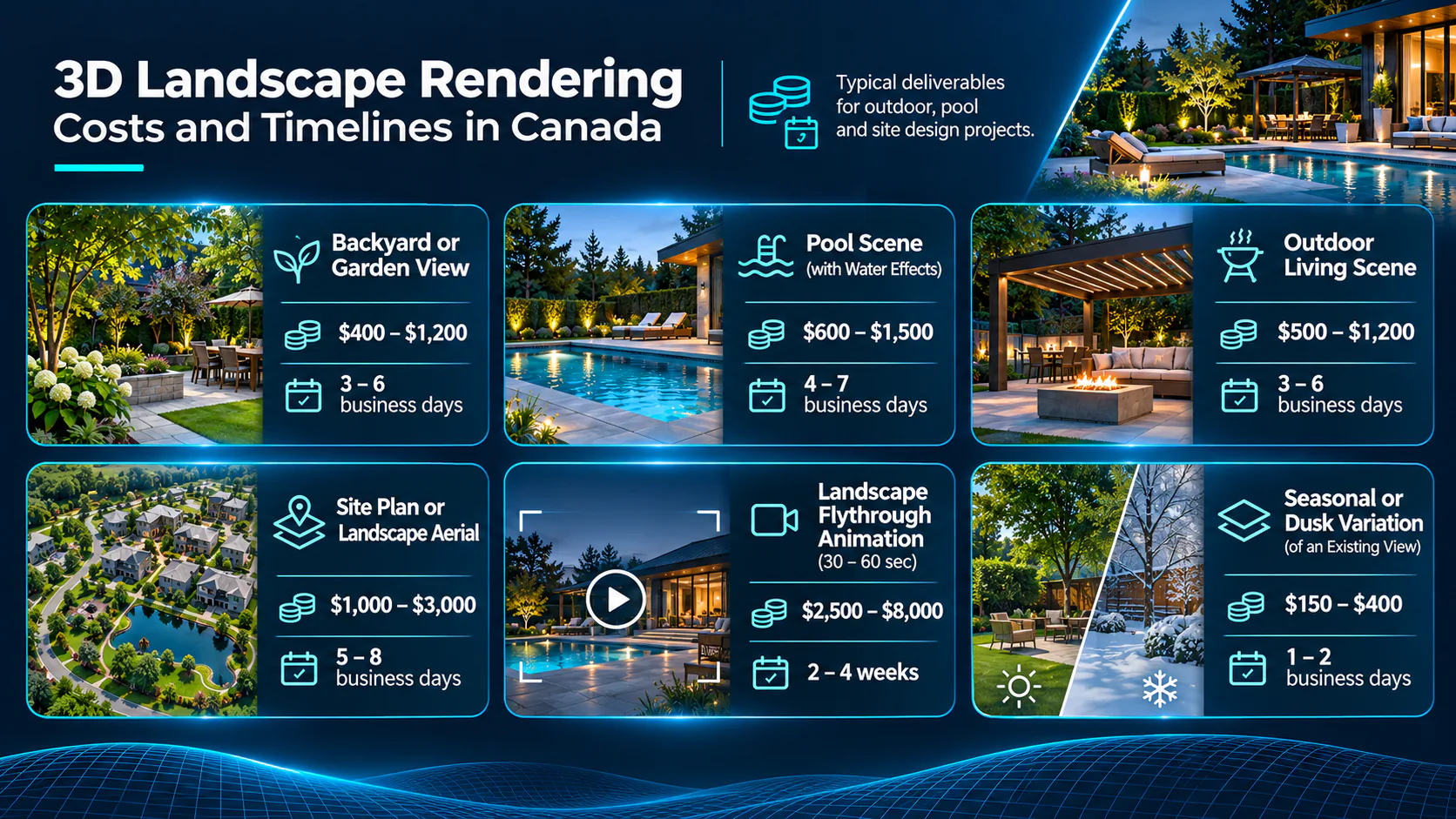
The variation row is the one to remember. Once the model exists, a second season, dusk version, or upgrade view costs a fraction of the first image. That is how one model powers an entire sales conversation. For building renders and animation, see our full guide to 3D rendering costs in Canada.
What do you need to provide for a landscape rendering?
A site plan with levels, a planting plan, hardscape selections, photos of the existing site, and the purpose of each image.
Landscape rendering starts from your design information. Better inputs mean faster, cheaper, and more accurate work:
- The site plan or landscape design, with dimensions and levels.
- The planting plan or plant list, so real species can be modeled.
- Hardscape materials, such as paver, stone, and decking selections.
- Photos of the existing site and house, since the building usually appears in the view.
- The purpose of each image, because a permit drawing and a sales image frame differently.
Our checklist of files needed for 3D rendering covers the building side of the brief.
How can Pyctom show clients the backyard before you build it?
We produce landscape, pool and site imagery for designers, contractors and developers across Canada, with region-appropriate planting and honest growth stages.
Outdoor projects are approved on trust, and renderings replace trust with sight. At Pyctom Labs, every image uses region-appropriate planting and honest growth stages. You can see outdoor work in our portfolio.
Send us your site plan and tell us what the client needs to see. The views follow from that answer.
Frequently asked questions
What is 3D landscape rendering?
It is the photorealistic visualization of outdoor spaces, built from site and planting plans. The image shows terrain, plants, hardscape, water, and lighting as the finished space.
How much does landscape rendering cost?
Single backyard views run $400 to $1,200 in Canada, and pool scenes $600 to $1,500. Site aerials run $1,000 to $3,000, and variations of an existing view cost far less.
Should plants be shown at installation size or maturity?
Either works, as long as the image says which. Many designers order both, using maturity for the vision and installation size for expectation setting.
Are pool renderings worth the extra cost?
Yes, for pool builders especially. Realistic water and evening lighting sell the project and support permits. They also close the household decision faster than plans ever do.
Can the same rendering show different seasons?
Yes. Summer, autumn, and winter versions come from the same model at a fraction of the cost. Winter views matter in Canadian projects.
Can homeowners order a landscape rendering directly?
Yes. Homeowners planning a major backyard or pool project order them to compare contractor proposals. The render settles the design before money is committed.
Do landscape contractors really use renderings for marketing?
Constantly. A rendered portfolio wins jobs before the first site visit, and upsell scenes convert upgrades that catalogues cannot.
Disclaimer: The information provided in this blog is for general informational purposes only. For professional assistance and advice, please contact experts.