
Real Estate Rendering: How Agents and Brokers Use CGI to Sell Listings Faster

Table of Contents
Every agent has met the listing that is better than its photos. Real estate rendering exists for exactly that gap. It gives buyers the picture their imagination refuses to draw, and homes sell at the speed of that picture. Listings with weak visuals sit longer, and sitting listings invite lowball offers and price cuts.
In this guide, we walk you through the real situations where CGI moves a listing, what each fix costs, and the disclosure rule that keeps it all clean.
Why do some listings struggle to connect with buyers?
Because most buyers can't see past what a room is today. They see the empty living room, not their furniture in it, and the oak kitchen, not the renovated one a modest budget would buy. The photos never make the argument, so the listing sits.
You know the house is right for them. But that gap has a price. Days on market pile up, the listing goes stale in the apps, and the first price reduction becomes the headline. Rendering attacks the gap directly, by showing buyers the version of the property they would actually pay for.
How do agents use real estate rendering to market listings?
In six recurring situations: vacant homes, winter exteriors, dated interiors, homes not yet built, vacant land and the listing presentation itself. Each one replaces a picture buyers can't imagine with one they can, usually within days rather than weeks.
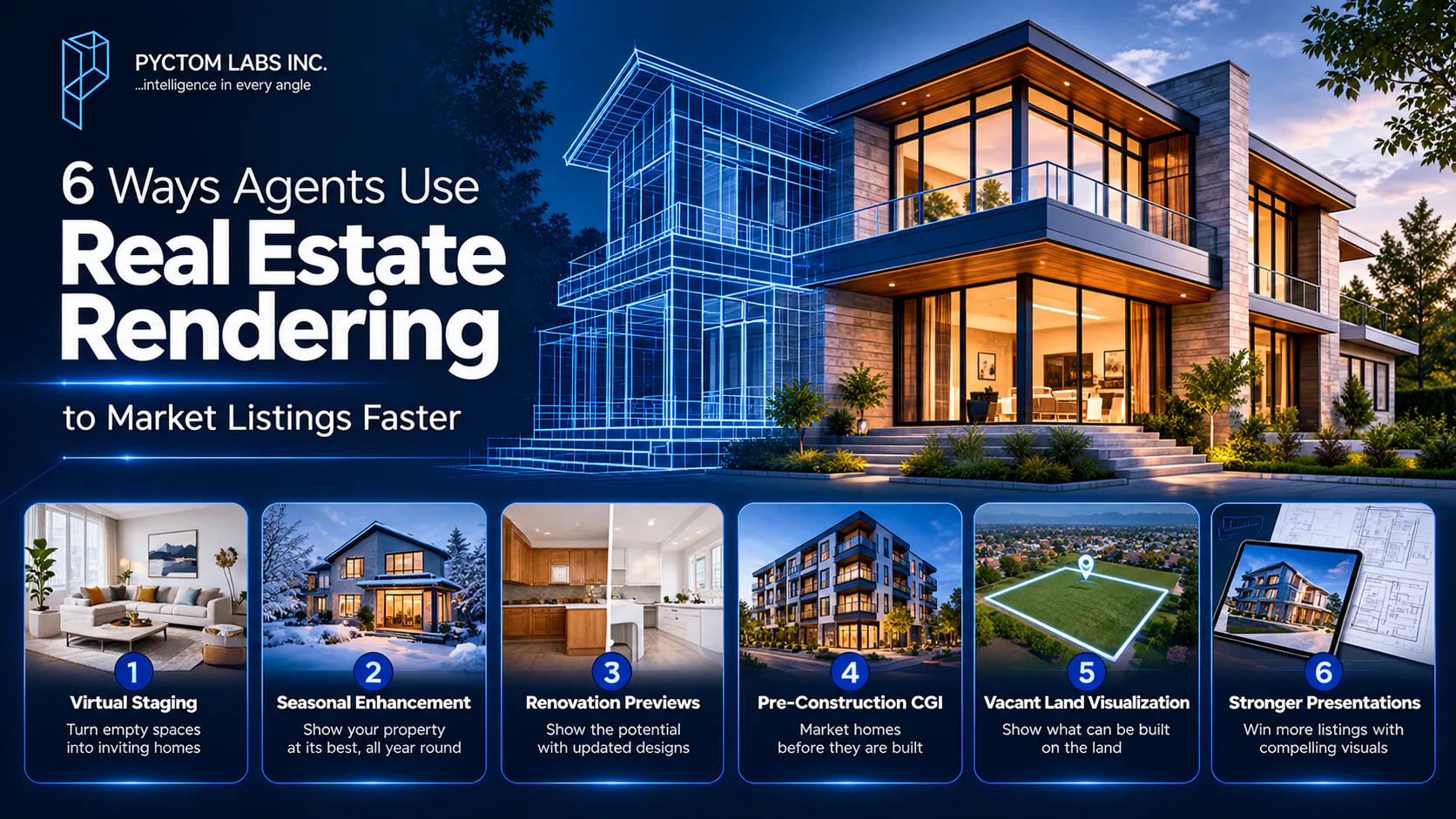
Each situation below happens in every brokerage, every season. Here is how CGI handles each one, and what it does to the timeline.
1. Virtual staging for vacant listings
The sellers moved out, the furniture left with them, and now every room photographs small and cold. Physical staging quotes come back in the thousands, with a two-week wait for furniture delivery.
Virtual staging solves it in days. The empty rooms are photographed once, and digitally furnished versions come back within two to three business days at a fraction of staging rental costs. The listing goes live styled, while the competing vacant unit down the hall is still waiting for a sofa.
2. Seasonal exterior enhancement
The house comes to market in February. The lawn is dead, the sky is grey, and the maple that makes the backyard is a bare stick. Buyers scrolling at night compare it against listings shot in June.
A rendered or digitally enhanced exterior shows the home in full summer, with green landscaping and warm light. You disclose the enhancement, keep the real photos available, and stop losing the first impression to the calendar.
3. Renovation previews for dated homes
The bones are great, the location is perfect, and the kitchen is proudly 1987. Every showing ends the same way, with buyers mentally subtracting a renovation they can't price and offers that subtract too much.
A virtual renovation render shows the same kitchen updated, next to the current photos. Buyers now bid on the potential with a real picture of it, and the renovation conversation happens with numbers instead of fear. Sellers who won't renovate before listing get most of the benefit for a few hundred dollars.
4. Pre-construction CGI for homes not yet built
Pre-construction sales, custom builds and assignments all share one problem. You are selling a home that exists only as drawings, and drawings don't get emotional offers.
This is where full house rendering carries the listing. A hero exterior, two or three interiors and a 3D floor plan let you market months before a photographer could shoot anything. The builder keeps selling through construction instead of waiting for occupancy, and carrying costs shrink with every early deal. Our guide to pre-construction renderings covers what a full launch package includes.
5. Vacant land visualization
Land listings sit because buyers see a field, a slope or a teardown, and stop there. The value is in what could stand on it, and that value is invisible.
A render of a buildable concept on the actual lot changes the conversation. The listing now sells a future home with an address, not a patch of grass, and the buyers it attracts are the ones who can close.
6. Stronger listing presentations
Sometimes the render sells the seller, not the buyer. Walking into a listing presentation with a virtually staged mockup of their own living room shows the owner exactly how you'll market the home. The agent with the CGI plan looks prepared. The agent with a generic slideshow looks like everyone else.
Agents who use this once tend to keep using it, because it wins the inventory that everything else depends on.
How do better visuals speed up a listing?
Rendering compresses the timeline at three points. The listing launches sooner, because imagery no longer waits for staging, seasons or construction. It converts better, because buyers arrive already sold on what they saw online. And the price holds longer, before the stale-listing discount begins.
For a seller, one avoided price reduction pays for every image many times over. For an agent, faster sales mean more turns per year from the same effort.
How much does real estate rendering cost in Canada?
Virtual staging runs $50 to $200 per photo and virtual renovation $150 to $400. Enhanced exteriors cost $150 to $500, 3D floor plans $150 to $600, and full renders of an unbuilt home $500 to $1,500 per view, most delivered within a week.
Pricing depends on the type of image, level of detail, number of views, available source material and required turnaround. Typical project ranges look like this:
| Service | Typical cost (CAD) | Turnaround |
|---|---|---|
| Virtual staging, per photo | $50 – $200 | 1 – 3 days |
| Virtual renovation, per photo | $150 – $400 | 2 – 4 days |
| Enhanced or seasonal exterior | $150 – $500 | 2 – 4 days |
| Full render of an unbuilt home | $500 – $1,500 per view | 3 – 7 days |
| 3D floor plan | $150 – $600 | 1 – 3 days |
For architectural projects beyond listing imagery, our 3D rendering cost guide for Canada breaks down prices by project type.
Disclosure is the one rule that protects everything above. Label virtually staged and enhanced images as such, keep original photos available, and never alter the property's actual condition. Most Canadian boards treat undisclosed digital alteration as a serious problem, and honest labelling costs you nothing with buyers.
What are the disclosure rules for rendered listing images?
Label virtually staged and conceptual images, keep the original photos available, and never change the property's physical condition. Rules differ between provinces, brokerages, real estate boards and MLS systems, so confirm the ones that apply to your listing before publishing.
Digitally altered real estate imagery should be handled carefully. As a general marketing practice:
- Identify virtual staging or conceptual imagery where required.
- Avoid edits that misrepresent the property's physical condition.
- Do not digitally remove defects or permanent property features.
- Keep original photographs available when required.
- Clearly distinguish proposed construction from completed construction.
- Confirm the rules of your brokerage, MLS system and local real estate board.
Good CGI should help buyers understand a property more clearly. It should never create a false impression of what currently exists.
Which type of CGI does your listing need?
Match the visualization to the listing's problem. A vacant home needs virtual staging, a dated one needs virtual renovation, a pre-construction property needs full CGI, and vacant land needs a concept render. A vacant condo and a redevelopment site rarely need the same solution.
- Vacant home: virtual staging
- Outdated interior: virtual renovation
- Pre-construction property: full CGI interior and exterior rendering
- Vacant land: conceptual architectural rendering
- Winter property: exterior visualization or carefully produced seasonal enhancement
- New development: exterior renders, interior renders, amenity imagery and 3D floor plans
- Luxury property: high-resolution interior and exterior visualization with detailed furniture, materials, landscaping and lighting
Matching the visualization method to the listing problem usually produces better marketing than applying the same solution to every property.
How do you get renderings for your listing?
Send the listing photos or drawings, tell the studio what buyers aren't seeing, and confirm the turnaround you need. A studio that prices per photo and works to listing timelines can usually have images ready before the listing goes live.
The listing that shows its best version sells first, and the agents who understand that own their market's inventory. At Pyctom Labs, we produce staging, renovation previews, and full interior and exterior imagery for agents and brokers across Canada, with per-photo pricing and turnarounds built for listing timelines. You can review real estate work in our portfolio.
Send us your listing and tell us what buyers aren't seeing. The images will show them.
Frequently asked questions
What is real estate rendering?
It is CGI imagery used to market property, including virtual staging, renovation previews, enhanced exteriors and full renders of unbuilt homes. Agents use it to show buyers what photos can't.
How much does real estate rendering cost?
Virtual staging runs $50 to $200 per photo, renovation previews $150 to $400, and full renders of unbuilt homes $500 to $1,500 per view.
Is virtual staging allowed on MLS?
Yes, with disclosure. Images must be labelled as virtually staged, originals should be available, and the property's real condition must not be altered or hidden.
How fast can rendered images be ready for a listing?
Virtual staging returns in one to three business days, and most other services within a week. That is usually faster than booking physical staging.
Does rendering work for luxury listings?
Yes, and expectations are higher there. Luxury buyers zoom, so professional-grade staging and rendering matter more as the price rises.
Can rendering help sell vacant land?
Yes. A rendered concept home on the actual lot shows buyers what the land supports, which is the value a field photo cannot show.
Disclaimer: The information provided in this blog is for general informational purposes only. For professional assistance and advice, please contact experts.